


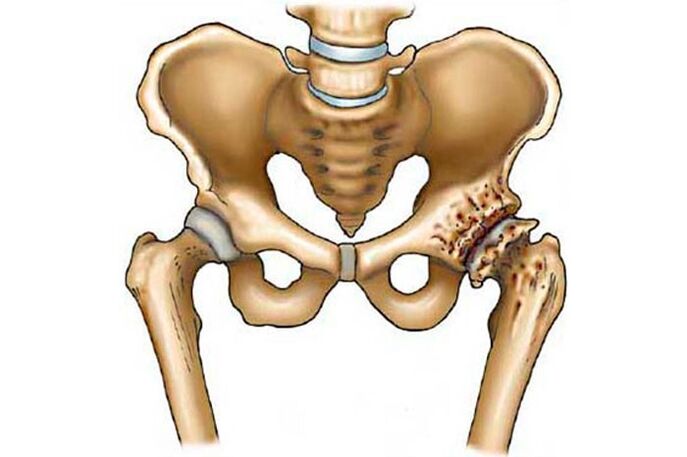
Arthrosis of the hip joint is a disease that also occurs under the name coxarthrosis, and usually affects people after forty years of age.Its cause is a decrease in the volume of synovial fluid secreted in the joint.According to medical statistics, women tend to suffer from coxarthrosis more often than men.It affects one or two hip joints.With this disease, the nutrition of the cartilage tissue is disrupted, which causes its subsequent destruction and limits the mobility of the joint.The main symptom of the disease is pain in the groin area.
Do not self-medicate.At the first signs of illness, consult a doctor.
Causes of the disease
The main factors that influence the development of the disease are:
- injuries and microtraumas of the hip joint;
- excess weight;
- load on joints due to the nature of the profession;
- infarction (necrosis) of the hip joint, which occurs as a result of taking various medications, suffering from stress, drinking alcohol in large quantities;
- congenital defect of joints in the pelvic area;
- arthritis (inflammatory processes in the joints);
- changes in hormonal levels (mainly age-related);
- osteoporosis (death of bone tissue).
Symptoms of the disease
Symptoms of arthrosis of the hip joint affect not only the groin area, but also the anterior and lateral surface of the thigh.In some cases, pain is also present in the buttocks, extending to the middle of the thighs, very rarely reaching the knee.The difference between this disease and herniated intervertebral discs is that the pain does not go down to the toes.Most often, discomfort occurs when moving.
In the early stages, the disease can contribute to a slight limp due to aching pain.Unfortunately, these signs do not lead many people to consider starting treatment.Then come exacerbations that last for different periods of time.Gradually, a decrease in the mobility of the affected leg is added to the previous symptoms.The patient sometimes cannot move the limb to the side or pull it to the chest.Also at this stage, the crunching of the sore leg during movement is added.It is necessary to distinguish the usual, ringing crunching of joints in a healthy person from the dull and “dry” arthrosis crunching, which is caused by increased friction of the joints against each other and the proliferation of osteophytes.
Deforming arthrosis of the hip joint can cause shortening of the affected leg (in 10% of patients, the leg, on the contrary, lengthens).This deformity is especially noticeable if the patient lies on his back, because this helps to rotate the affected leg outward.Significant deformations are visually noticeable and require additional insoles to be placed in the shoes.The patient begins to noticeably limp when walking, as a result of which the spine will be subjected to heavy loads in the lumbar region.Later, muscle atrophy occurs.
Degrees of coxarthrosis
There are three stages of development of this disease:
- Stage 1.With it, pain appears only after strong physical exertion, and it appears only in the pelvic area and rarely reaches the hip or knee joint.During rest, the pain goes away, and other symptoms do not appear (freedom of movement is not impaired, muscle weakening is not observed).The disease affects the bones that are located near the joint and promotes their growth.On an x-ray, you can see uneven narrowing of the diseased joints.In this case, the patient does not notice a noticeable limitation in the mobility of the legs.In this phase, the disease is most easily cured with the help of drugs, exercise therapy and physiotherapy, but few people with the above symptoms turn to a specialist;
- Stage 2.Osteoarthritis of the hip joint of the 2nd degree can be seen on an x-ray by a characteristic sign - significant bone growths that go beyond the cartilage.The head of the femur bone also changes, deforming in contour.A cyst may appear.Painful sensations now appear in the patient even in a state of rest.The strength of the muscles responsible for extension is also lost and the ability to rotate the hip is impaired;
- Stage 3.The pain continues constantly, and the person cannot walk without aids (canes).The affected limb also shortens and the muscles atrophy.In this case, the joint space may disappear completely, which will provoke the fusion of the joints into a single bone structure that will be immobile.
Treatment methods
There are several ways to combat the disease:
- medicines;
- physical therapy complex (physical therapy complex);
- physiotherapy;
- surgical intervention;
- traditional medicine.
If the disease has reached stage 3, then the only thing that will help the patient is surgical intervention (endoprosthetics), which is the replacement of a diseased joint with a prosthesis.This is a rather complex procedure that requires the implantation of a prosthesis.Only then will he perform the necessary functions.
If the pathology is at stage 1 or 2, treatment of hip arthrosis can be carried out with the help of medications.These include the following drugs:
- non-steroidal.They will help eliminate pain, relieve swelling and inflammation, but their uncontrolled use will help suppress the natural ability of cartilage to recover.Doctors do not recommend using more than one nonsteroidal drug at a time;
- dilating vessels.They are able to relax smooth muscles and increase the space between muscles.They have a minimum of contraindications, but their effectiveness is an individual indicator;
- relaxing muscles.Relieve muscle spasms, increase blood supply to joints, but their use should be under medical supervision due to side effects;
- restoring cartilage.Chondroprotectors are the most useful in curing deforming arthrosis.They nourish the cartilage with the necessary elements and stop the development of the disease;
- steroid type.They help with concomitant diseases such as inflammation of the hip bone, but have many side effects;
- local use (ointments, compresses).The main positive effect lies in the process of rubbing the products into the skin, which relieves muscle spasms and improves blood circulation.
Physiotherapy for arthrosis
How to treat arthrosis of the hip joint using physiotherapeutic methods?It is worth using UHF, ultrasound therapy, inductothermy, lasers and light treatment.Therapeutic procedures help improve blood circulation and relieve muscle spasms, so are ideal for prevention, but affect each person individually.Some physical therapists believe that one of the best treatments is massage.
Treatment of hip arthrosis using joint traction is also one of the most effective treatments.It can be performed using a traction apparatus or manually.The first method helps to correctly calculate the traction to millimeters, taking into account the patient’s condition.The second method is partly folk and more labor-intensive, because it requires the utmost concentration of the therapist.
Diet
Diet for arthrosis of the hip joint is an excellent prevention, but the exact extent of its influence in the treatment process has not been proven.The main rules of nutrition are to eat foods rich in vitamins A, B, C, E, as they help restore cartilage.It is recommended to include dairy products in the diet, with the exception of milk, and products made from white flour (corn, wheat) should be excluded from the diet.It is worth consuming meat products in moderation, as well as increasing the consumption of cereals in the diet (barley, oatmeal, buckwheat, brown rice).Nutrition during illness also requires limiting salt intake.This has a secondary effect on recovery, but is an excellent prevention of the development and occurrence of the disease.
Gymnastics
Gymnastics for arthrosis of the hip joint causes lively debate among specialists, but all doctors agree that exercises to combat and prevent coxarthrosis should be carried out carefully.Movements during exercise therapy should be smooth and not cause pain.Exercise therapy for the treatment of an illness should be aimed mainly at strengthening the muscles themselves and not loading the joints.A good way to prevent coxarthrosis is swimming, especially in salt water.
Gymnastics for arthrosis of the hip joint includes the following exercises:
- starting position: lie on the floor, stretch your arms and legs along your body.Slowly raise the sore leg, straightened at the knee joint, 15 cm from the floor and hold it for about half a minute.After this, lower your leg and repeat the exercise with the other leg;
- starting position: lie on your stomach, stretch your legs and arms along your body.Raise your straight legs 15 cm up, bring them together, and then spread them apart.Everything should be done slowly.Physical therapy is an effective method for treating arthrosis.
The patient should remember that some exercises for arthrosis of the hip joint from exercise therapy may be difficult for him due to his physical fitness.They are quite effective methods of preventing various ailments, therefore they are included in the exercise therapy system both for arthrosis and for other diseases.
Traditional medicine
Among the traditional methods of treating and preventing the disease are:
- applying cabbage leaves smeared with honey to the sore spot;
- Mix iodine with bile, glycerin, honey, ammonia and apply as a compress.
Such folk methods are not very encouraged by medicine, but numerous positive reviews on the Internet make treatment with folk remedies very popular among people.